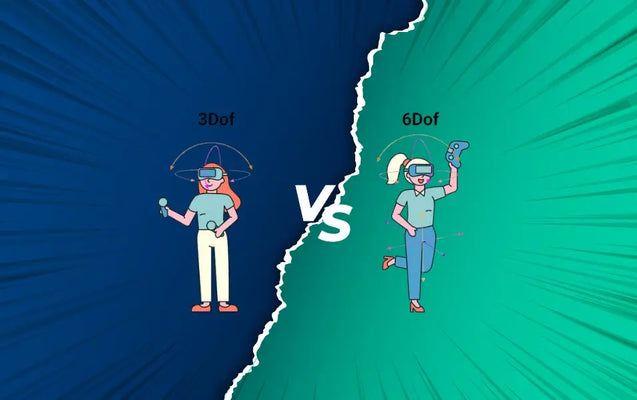


3DoF vs. 6DoF vs. 9DoF in AR glasses directly impacts how immersive your spatial computing feels—especially with the birdbath (BB) optics and multi-screen setups you asked about earlier. DoF = Degrees of Freedom: the independent ways your head (and virtual content) can move and be tracked in 3D space. In AR glasses, this determines whether screens feel “stuck to your face,” anchored to your body, or locked to the real world around you.
Quick Breakdown
- 3DoF: Tracks only head rotation (yaw/left-right, pitch/up-down, roll/tilt). No body position tracking.
- 6DoF: Tracks rotation + position (forward/back, left/right, up/down). Full head pose in real space.
- 9DoF: Not “extra movement freedom”—it’s a sensor fusion term. Combines 3-axis gyroscope + 3-axis accelerometer + 3-axis magnetometer (9-axis IMU). Improves accuracy and reduces drift in 3DoF or 6DoF systems. In practice, it’s marketing-speak for “more precise 6DoF” in many AR glasses.
Side-by-Side Comparison
|
Feature
|
3DoF (Your BB glasses today)
|
6DoF (Next-level spatial AR)
|
9DoF (Precision-enhanced)
|
|---|---|---|---|
|
What it tracks
|
Head rotation only (pitch/yaw/roll)
|
Rotation + translation (x/y/z position)
|
9-axis IMU fusion for ultra-stable orientation + position
|
|
Screen behavior
|
Body-anchored or smooth-follow (screens stay relative to you)
|
World-anchored (screens stay fixed in real space even if you walk)
|
Same as 6DoF but with less drift & better heading accuracy
|
|
Multi-screen immersion
|
Excellent for productivity/video (multiple stable floating monitors)
|
Truly spatial—screens can be placed on walls, tables, or objects
|
Highest precision for anchored multi-windows + overlays
|
|
Motion sickness risk
|
Low (gentle, predictable)
|
Higher if tracking is poor; otherwise, very natural
|
Lowest drift = smoothest experience
|
|
Hardware needed
|
Basic IMU (gyro + accel) + companion device (e.g., Beam)
|
Cameras + advanced IMU + SLAM/VIO inside-out tracking
|
9-axis IMU (often paired with visual tracking for full 6DoF)
|
|
Best for
|
Every day multitasking, video, 3D content on BB glasses
|
Gaming, navigation, object interaction, true AR
|
High-accuracy enterprise, robotics, or premium consumer AR
|
|
Current examples
|
XREAL Air/One series + Beam Pro, RayNeo Air 4 Pro, Viture (most BB glasses)
|
Snap Spectacles 5, Magic Leap 2, Meta Orion prototypes, some XREAL upgrades
|
Many “6DoF” glasses marketed with 9DoF IMUs for stability
|
|
Cost & Availability
|
Affordable & widely available now (your BB setup)
|
More expensive, emerging in 2025–2026 consumer models
|
Usually bundled into premium 6DoF systems
|
How This Feels in Real Use (Tied to Your BB AR Glasses)
Most consumer BB AR glasses (like your setup) start with excellent 3DoF spatial computing because it’s lightweight, low-power, and perfect for multi-screen immersion without bulk. 6DoF is the future for true “spatial computing” (world-locked AR), and 9DoF is the hidden tech making both feel buttery-smooth. If you love your current multi-screen workflow, 3DoF is more than enough today—6DoF is the upgrade path when you want to move with your content.
- 3DoF (what you have now): Your multi-screen experience is already “more immersive” than basic mirroring because screens follow your body smoothly when you turn your head. Great for sitting at a desk or couch—feels like giant persistent monitors. No need to walk around for it to work perfectly.
- 6DoF upgrade: Walk across the room, and virtual screens stay exactly where you placed them in the real world (e.g., one on the wall, one floating by the window). Perfect for room-scale productivity or AR apps that interact with physical objects. Many BB glasses can be upgraded to 6DoF via accessories or future firmware.
- 9DoF benefit: Adds a magnetometer so direction doesn’t drift over time (common 3DoF/6DoF issue indoors). You get rock-solid anchors without recalibrating—especially useful in 6DoF systems for long sessions or outdoor use.
Most consumer BB AR glasses (like your setup) start with excellent 3DoF spatial computing because it’s lightweight, low-power, and perfect for multi-screen immersion without bulk. 6DoF is the future for true “spatial computing” (world-locked AR), and 9DoF is the hidden tech making both feel buttery-smooth. If you love your current multi-screen workflow, 3DoF is more than enough today—6DoF is the upgrade path when you want to move with your content.